
Prefectures of Japan is something unique to the Island of Japan. Let’s begin with a simple question of what is a prefecture? The prefecture is Japan’s jurisdiction and there are 47 prefectures or jurisdictions.
In Japanese, the prefectures of Japan are commonly referred toas todōfuken. The prefectures are governmental bodies larger than cities, towns, and villages.
The elected governor is the chief executive of each prefecture. Each prefecture is subdivided into cities (市 shi) and districts (郡 gun), then the district is further subdivided into towns (町 chō or machi) and villages (村 son or mura).
Prefecture Background
The current system of Prefecture came into existence after the abolition of the Han system in July 1871. The Meiji government reduced the Han system’s 300 prefectures to 72 in the latter part of 1871, and 47 in 1888.
Though the Japanese language classes remains the official language of Japan, a number of indigenous languages are still spoken in each prefecture.
From the map below, try to find out out what prefecture is Tokyo in or what prefecture is Osaka in?
Map – 47 Prefectures of Japan
Regions:
- Hokkaido
- Tohoku
- Kanto
- Kansai
- Shikoku
- Kyushu
- Chugoku
- Chubu
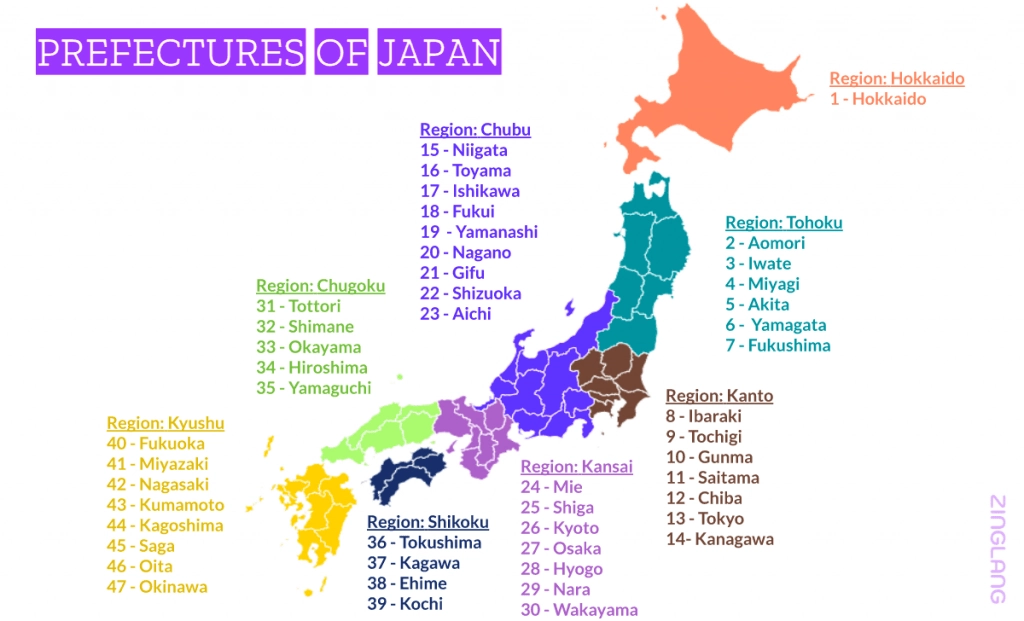
Tokyo is in Tokyo prefecture (however Tokyo Megalopolis Region consists of Tokyo and three neighboring prefectures. Osaka is in Osaka prefecture.
Check out Common Phrases in the Japanese Language.
List of 47 Prefectures of Japan
Hokkaidō Region
- Hokkaidō
Tōhoku Region
- Aomori Prefecture
- Iwate Prefecture
- Miyagi Prefecture
- Akita Prefecture
- Yamagata Prefecture
- Fukushima Prefecture
Kantō Region
- Tokyo
- Kanagawa Prefecture
- Chiba Prefecture
- Saitama Prefecture
- Ibaraki Prefecture
- Tochigi Prefecture
- Gunma Prefecture
Chūbu Region
- Niigata Prefecture
- Toyama Prefecture
- Ishikawa Prefecture
- Fukui Prefecture
- Yamanashi Prefecture
- Nagano Prefecture
- Gifu Prefecture
- Shizuoka Prefecture
- Aichi Prefecture
Kansai (Kinki) Region
- Kyoto Prefecture
- Osaka Prefecture
- Hyōgo Prefecture
- Nara Prefecture
- Shiga Prefecture
- Wakayama Prefecture
- Mie Prefecture
Chūgoku Region
- Tottori Prefecture
- Shimane Prefecture
- Okayama Prefecture
- Hiroshima Prefecture
- Yamaguchi Prefecture
Shikoku Region
- Tokushima Prefecture
- Kagawa Prefecture
- Ehime Prefecture
- Kōchi Prefecture
Kyūshū & Okinawa Region
- Fukuoka Prefecture
- Saga Prefecture
- Nagasaki Prefecture
- Kumamoto Prefecture
- Ōita Prefecture
- Miyazaki Prefecture
- Kagoshima Prefecture
- Okinawa Prefecture
Japan’s prefectures vary widely in size, culture, climate, and population. For example, Tokyo is the political and economic center of the country, while Okinawa Prefecture is known for its tropical islands and unique Ryukyuan culture.
Travel guide: Are you planning to visit Japan? Then, discover the 10 Must-Visit Prefectures in Japan (by Tripzilla).