
Prefectures of Japan is something unique to the Island of Japan. Let’s begin with a simple question of what is a prefecture? The prefecture is Japan’s jurisdiction and there are 47 prefectures or jurisdictions.
In Japanese, the prefectures of Japan are commonly referred toas todōfuken. The prefectures are governmental bodies larger than cities, towns, and villages. The elected governor is the chief executive of each prefecture. Each prefecture is subdivided into cities (市 shi) and districts (郡 gun), then the district is further subdivided into towns (町 chō or machi) and villages (村 son or mura).
Prefecture Background
The current system of Prefecture came into existence after the abolition of the Han system in July 1871. The Meiji government reduced the Han system’s 300 prefectures to 72 in the latter part of 1871, and 47 in 1888.
Though the Japanese language classes remains the official language of Japan, a number of indigenous languages are still spoken in each prefecture. From the map below, try to find out out what prefecture is Tokyo in or what prefecture is Osaka in?
Map – 47 Prefectures of Japan
Regions:
- Hokkaido
- Tohoku
- Kanto
- Kansai
- Shikoku
- Kyushu
- Chugoku
- Chubu
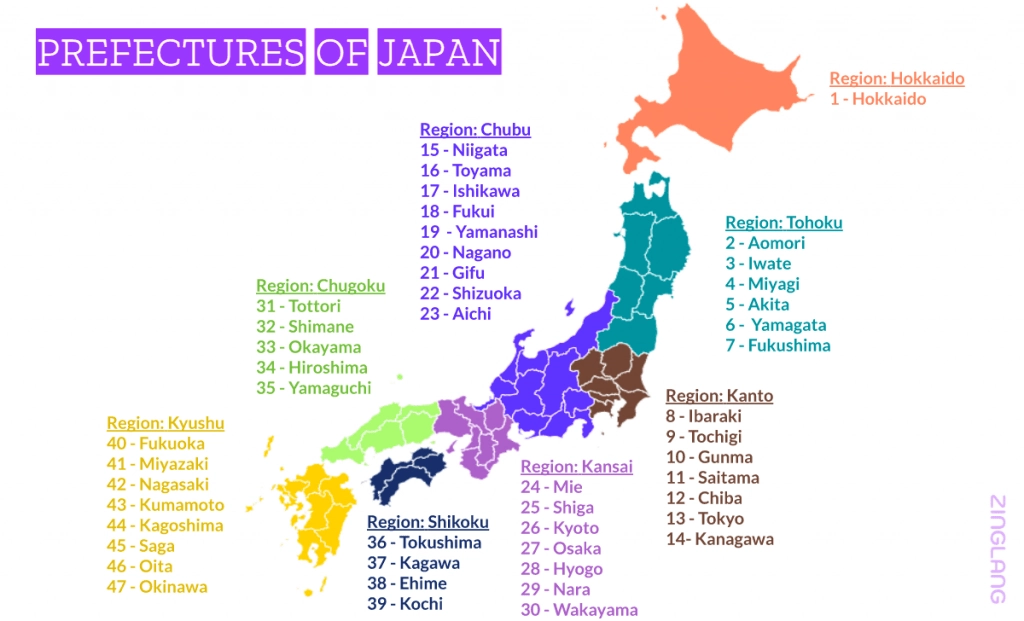
Tokyo is in Tokyo prefecture (however Tokyo Megalopolis Region consists of Tokyo and three neighboring prefectures. Osaka is in Osaka prefecture.
Check out Common Phrases in the Japanese Language.
List of 47 Prefectures of Japan
1. Hokkaido Region
Hokkaido Prefecture
Hokkaido is Japan’s northernmost and largest prefecture by area. It is famous for its snowy winters, mountains, forests, agriculture, seafood, and natural landscapes. Sapporo, the prefectural capital, is one of Japan’s major cities.
Hokkaido also has a distinctive history connected with the Ainu people, the Indigenous people of northern Japan. During the Meiji period, the Japanese government increased settlement and development in Hokkaido. Today, the prefecture is well known for winter sports, national parks, dairy products, seafood, and Ainu cultural heritage.
2. Tohoku Region
The Tohoku region is located in the northeastern part of Japan’s main island, Honshu. It consists of six prefectures:
- Aomori Prefecture
- Iwate Prefecture
- Miyagi Prefecture
- Akita Prefecture
- Yamagata Prefecture
- Fukushima Prefecture
Tohoku is known for its mountains, forests, hot springs, traditional festivals, agriculture, and heavy snowfall in winter. Aomori is famous for the Nebuta Festival, while Iwate has important historical sites such as Hiraizumi.
Miyagi, with Sendai as its capital, is one of the region’s major economic and cultural centers. Akita is known for traditional culture and local cuisine, while Yamagata is famous for mountains, temples, hot springs, and agricultural products. Fukushima has diverse landscapes ranging from mountains to coastal areas.
The region was heavily affected by the 2011 earthquake and tsunami, which became an important part of its modern history.
3. Kanto Region
Kanto is home to Japan’s capital and largest metropolitan area. It contains seven prefectures:
- Tokyo
- Kanagawa Prefecture
- Chiba Prefecture
- Saitama Prefecture
- Ibaraki Prefecture
- Tochigi Prefecture
- Gunma Prefecture
Tokyo is Japan’s political, economic, and cultural center. Historically, the area became especially important during the Edo period, when the Tokugawa shogunate established its government in Edo, present-day Tokyo.
Kanagawa is home to Yokohama and historic Kamakura. Chiba is known for its coastline and proximity to Tokyo, while Saitama forms part of the Greater Tokyo metropolitan area. Tochigi is famous for Nikko and its historic temples and shrines. Gunma is known for mountains and hot springs, while Ibaraki offers agricultural areas, coastal landscapes, and historical attractions.
4. Chubu Region
Chubu is located in central Honshu and includes nine prefectures:
- Niigata Prefecture
- Toyama Prefecture
- Ishikawa Prefecture
- Fukui Prefecture
- Yamanashi Prefecture
- Nagano Prefecture
- Gifu Prefecture
- Shizuoka Prefecture
- Aichi Prefecture
The region contains mountains, coastlines, traditional towns, and major industrial centers. Yamanashi and Shizuoka are strongly associated with Mount Fuji. Nagano is famous for the Japanese Alps and winter sports.
Ishikawa is known for traditional crafts and Kanazawa, while Gifu has historic mountain villages and traditional architecture. Aichi, with Nagoya as its capital, is an important industrial center and has strong connections to Japan’s samurai history.
Chubu’s geographical diversity makes it one of Japan’s most varied regions.
5. Kansai (Kinki) Region
Kansai is one of Japan’s most historically significant regions. It consists of seven prefectures:
- Kyoto Prefecture
- Osaka Prefecture
- Hyogo Prefecture
- Nara Prefecture
- Shiga Prefecture
- Wakayama Prefecture
- Mie Prefecture
Kyoto was Japan’s imperial capital for more than a thousand years and remains famous for temples, shrines, gardens, traditional arts, and historic architecture.
Nara was an earlier capital of Japan and is closely connected with the development of Buddhism and ancient Japanese culture. Osaka developed as an important commercial center and is famous for its food culture and lively urban atmosphere.
Hyogo is home to Kobe and Himeji Castle, while Shiga surrounds Lake Biwa, Japan’s largest freshwater lake. Wakayama is known for temples, mountains, and pilgrimage routes, while Mie is strongly associated with Ise Jingu.
6. Chugoku Region
The Chugoku region occupies western Honshu and contains five prefectures:
- Tottori Prefecture
- Shimane Prefecture
- Okayama Prefecture
- Hiroshima Prefecture
- Yamaguchi Prefecture
Tottori is famous for its large sand dunes, while Shimane has deep connections with Japanese mythology and the famous Izumo area.
Okayama is known for its historic gardens and castle, while Hiroshima has global historical importance because of the atomic bombing in 1945. Today, Hiroshima’s Peace Memorial sites promote remembrance and peace.
Yamaguchi has a rich history and played an important role during the political changes that led to the Meiji Restoration.
7. Shikoku Region
Shikoku is Japan’s smallest of the four main islands and consists of four prefectures:
- Tokushima Prefecture
- Kagawa Prefecture
- Ehime Prefecture
- Kochi Prefecture
Shikoku is particularly famous for the Shikoku 88 Temple Pilgrimage, a major Buddhist pilgrimage associated with Kobo Daishi.
Tokushima is famous for the Awa Odori dance festival. Kagawa is well known for Sanuki udon, while Ehime is famous for Dogo Onsen and historic Matsuyama. Kochi has a strong connection with samurai and political history and is known for its beautiful Pacific coastline.
8. Kyushu & Okinawa Region
The southern region includes eight prefectures:
- Fukuoka Prefecture
- Saga Prefecture
- Nagasaki Prefecture
- Kumamoto Prefecture
- Oita Prefecture
- Miyazaki Prefecture
- Kagoshima Prefecture
- Okinawa Prefecture
Fukuoka is a major economic center and an important gateway to Asia. Nagasaki has a unique international history and was one of Japan’s main points of contact with foreign countries during the period of restricted international trade.
Kumamoto is famous for Kumamoto Castle, while Oita is known for its hot springs, particularly Beppu. Miyazaki is known for its natural beauty and mythology, and Kagoshima is famous for Sakurajima and its volcanic landscapes.
Okinawa Prefecture
Okinawa has a particularly distinctive history. Before becoming part of modern Japan, the islands were home to the Ryukyu Kingdom, which maintained extensive trading relationships with China, Japan, Korea, and Southeast Asia.
Okinawa became a prefecture in 1879. Its culture, music, cuisine, traditional arts, and language varieties reflect its unique historical development. Today, Okinawa Prefecture is famous for its tropical climate, beaches, coral reefs, and Ryukyuan cultural heritage.
Japan’s prefectures vary widely in size, culture, climate, and population. For example, Tokyo is the political and economic center of the country, while Okinawa Prefecture is known for its tropical islands and unique Ryukyuan culture.
Travel guide: Are you planning to visit Japan? Then, discover the 10 Must-Visit Prefectures in Japan (by Tripzilla).